
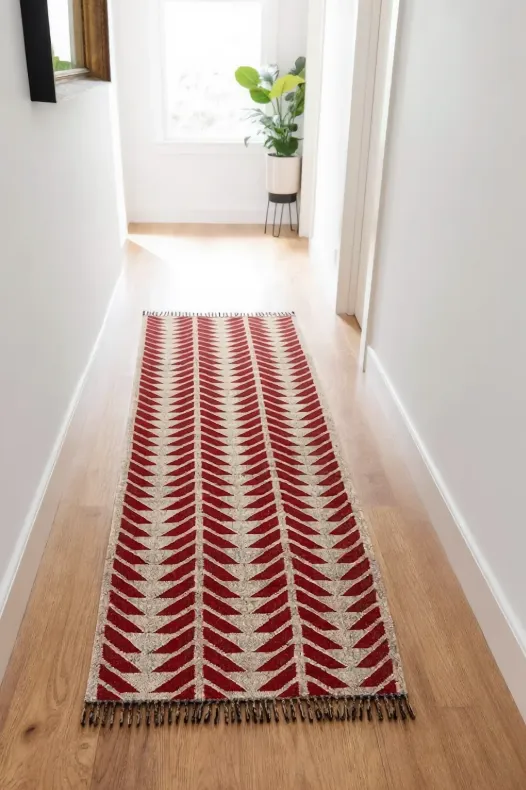
Most people shopping for a carpet for hall make one very predictable mistake: they start with colour. Will beige suit? Will blue match better? Does the pattern look modern?
Wrong starting point.
The hall is not like a bedroom. It is usually the most socially active, visually exposed, and frequently walked-through part of an Indian home. Guests enter it. Family members cross it all day. Tea spills happen. Children play there. During festivals, it suddenly becomes the centre of the house.
So the real question is not: “Which carpet will look nice in my hall?” It is:“What should this carpet make my hall do better?”
That shift changes everything. A good carpet for hall should bring order to an otherwise scattered space. It should tell your sofa, chairs, and centre table, “You lot belong together.”
And frankly, that is where most bad carpet buying begins: people buy decoration when what they actually need is structure.
Your Hall Does Not Need a Carpet Everywhere. It Needs a Clear Centre.
The biggest job of a carpet for hall is to create a visual centre around the seating area. Many Indian halls are designed around the walls. Sofa against one wall. TV unit against another. Chairs wherever there was space. Centre table floating in the middle as it arrived separately.
The room technically works. But it often does not feel connected. That is where a handmade carpet becomes useful.
A hall carpet can create one clear “living zone”
- It visually groups the sofa and chairs together.
- It gives the centre table a proper context.
- It separates the seating area from the rest of the room.
- It makes an open or oversized hall feel less scattered.
- It gives the eye one place to land.
Key rule: A carpet for hall should define the seating arrangement, not simply cover the empty floor in front of the sofa.
This is also why carpet size matters far more than people think. A very small carpet placed in the centre of a large hall often makes the entire room feel poorly proportioned. The rug should be chosen in relation to the furniture layout, not simply because a particular size happens to be available.
Do not measure only the hall. Measure the seating arrangement. That is the space your carpet is actually trying to organise.
The “Middle of the Hall” Is Usually the Worst Place to Put a Small Carpet
A small traditional carpet placed randomly in the middle of a hall is one of the fastest ways to make the room look unfinished. We have all seen it: a large room, a large sofa, a large centre table, and then one 3×5 carpet sitting in the middle with absolutely no relationship to anything around it. That carpet is not anchoring the room. It is decorating a patch of floor.
A better way to place a carpet for hall
Depending on your layout, consider:
- Front legs of the sofa on the carpet: A balanced option for many Indian halls.
- All major furniture on the carpet: Better for larger halls where you want one cohesive seating zone.
- A defined coffee-table zone: Works in compact halls, provided the carpet still looks proportionate.
- Multiple rugs: Useful only when the hall genuinely has separate functional zones.
The simple test: If you remove the carpet and the furniture suddenly looks scattered, the handmade carpet is doing its job.
If nothing changes, it was probably too small or poorly placed.
Carpet Practicality Matters More Than the Perfect Pinterest Look
The best carpet for hall is one you can actually live with without becoming its full-time caretaker. This is where many buying guides become completely disconnected from Indian reality.
A hall carpet has to survive:
- Dust from daily life.
- Foot traffic.
- Guests.
- Food and drink spills.
- Children.
- Pets.
- Shoes in some households.
- Monsoon humidity in many parts of India.
So no, the softest, whitest, fluffiest carpet is not automatically the best choice.
Choose based on your actual hall
For a busy family hall: Look for durable materials and practical constructions that suit frequent use.
For homes with children or pets: Low-pile or easier-care options can be more practical than very thick, delicate surfaces.
For a formal hall: You can take more design risks because the traffic may be lower.
For dusty environments: Mid-tones, patterns and textured surfaces may visually hide everyday dust better than extremely light solids.
For compact halls: Avoid a carpet that adds too much visual weight. A lighter palette or subtle pattern can keep the space from feeling crowded.
Material, pile and construction should be matched to the way the room is actually used. Wool, cotton, jute and synthetic fibres each come with different trade-offs in durability, comfort and maintenance. A handmade carpet for hall should survive your home before it impresses your guests.
So, What Is the Best Carpet for Hall?
The best carpet for hall is the one that makes the room feel organised, proportionate, and easier to live in.
Not the one with the loudest pattern.
Not the cheapest one during a sale.
Not the one that looked good in a perfectly styled product photo.
Before buying, ask these questions:
- Does this carpet relate to my furniture size?
- Will it define the seating area?
- Is the material practical for my daily life?
- Does the colour work with the lighting in my hall?
- Will the pattern still make sense after the novelty wears off?
- Is this the right size for the layout, not just the floor?
A good carpet for hall should make you feel that the room was designed around it. A bad one makes you feel that it was thrown in afterwards. That is the difference.
An authentic handmade carpet is not there to fill the floor. It is there to give the hall a centre of gravity.