

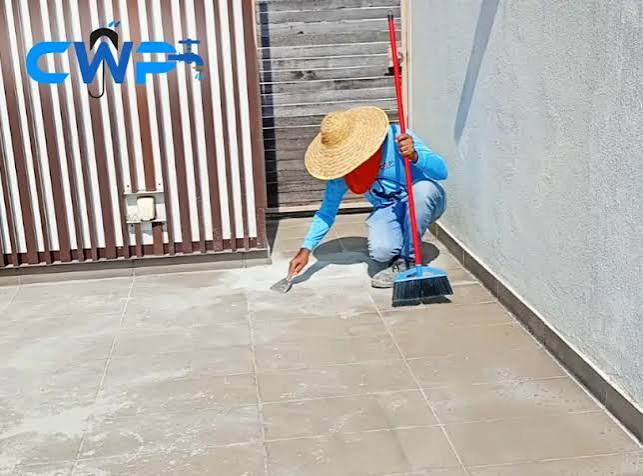
Cementitious waterproofing is the most commonly used and most commonly misused system in the region. It is cheap, forgiving to apply and available from every supplier, which means it ends up specified in places it was never designed for. Understanding exactly what it is, and what it physically cannot do, prevents the single most avoidable category of waterproofing failure.
What Cementitious Waterproofing Actually Is
A cementitious waterproofing product is a blend of Portland cement, graded silica sand, and chemical additives, usually supplied either as a single powder mixed with water or as a two-component kit with a liquid polymer instead of water. Once cured, it forms a rigid or semi-rigid mineral coating chemically bonded to the substrate.
There are three broad grades worth distinguishing:
-
Rigid cementitious slurry. Powder plus water. Very low cost, no flexibility at all. Suitable only for substrates with negligible movement, such as water tank interiors and lift pits.
-
Polymer-modified (flexible) cementitious. Two-component, with an acrylic or SBR liquid. Typical elongation of 5 to 15 percent, which is enough to accommodate shrinkage hairlines but not structural movement.
-
Crystalline cementitious. Contains reactive chemicals that grow crystals into the concrete’s capillary pores, sealing from within. Different mechanism, different use case.
The confusion in the market comes from “flexible” appearing on the tin. Flexible in this context means measured in single-digit percentages. A liquid polyurethane offers 300 percent or more. The words are the same, the performance is not comparable.
Where It Genuinely Performs
Internal wet areas
Bathrooms, showers, kitchens, laundry rooms and balconies with tiled finishes are the classic application. The coating goes on a screed or concrete slab, receives a reinforcing fabric at wall-floor junctions and around drains, and is then tiled over. Because it is protected from UV and thermal cycling by the tile finish, and because the substrate barely moves, cementitious coatings routinely last the life of the bathroom.
Two details do most of the work here. First, the coating must turn up the wall by at least 150mm, and to full shower height in wet zones. Second, the drain junction needs a bonded flange or reinforcing tape, because that is where almost every bathroom leak originates.
Water tanks and water-retaining structures
Potable water tanks are a natural fit. The coating is mineral rather than organic, so with the correct certified grade it does not taint water, and the tank interior is under compressive water pressure that pushes the coating onto the substrate rather than off it. Rigid grades are entirely acceptable here because a properly constructed tank does not flex.
Basements under positive pressure
Where a basement wall can be treated on the external, water-facing side, a cementitious system works well because hydrostatic pressure holds it in place. Applied internally, against negative pressure, the same coating is being pushed off the wall and needs a specialist negative-side product.
As a preparatory layer
Cementitious coatings are often used beneath other systems to level a rough deck, fill blowholes and provide a uniform absorbent surface. Used this way they are not the waterproofing layer at all, they are the substrate for it, and that is a perfectly legitimate role.
Where It Fails, and Why
Exposed roofs
This is the big one. A concrete roof deck in the Gulf can exceed 60°C at the surface and drop substantially overnight. That daily expansion and contraction opens and closes microcracks continuously. A coating with 8 percent elongation cannot accommodate that movement, so it cracks in sympathy with the substrate. Water then enters through the crack and travels laterally under the coating, which makes the eventual leak appear metres from the actual breach.
The correct answer for an exposed roof is a system with real elasticity or a sheet waterproofing membrane with a protective layer. Cementitious on a roof is a false economy that typically fails within three to five summers.
Across movement joints
Any joint designed to move needs a joint sealant or a bandage detail with a bond breaker. Painting a rigid coating across it guarantees a crack in exactly that line.
On unstable or contaminated substrates
Cementitious coatings bond chemically to the substrate. If there is laitance, curing compound residue, dust or an old paint layer, the bond fails and the coating debonds in sheets. Mechanical preparation, usually grinding or captive-blasting, is not optional.
Against aggressive salts
In coastal locations, sulphate and chloride attack degrades ordinary cementitious coatings over time. Where salt air corrosion UAE conditions apply, either use a sulphate-resisting grade or accept a shorter maintenance cycle. A standard product specified for an inland villa will not perform identically on a beachfront tower.
Application: The Six Things That Determine Success
-
Substrate preparation. Grind or blast to a sound, open surface. Repair honeycombing and blowholes first.
-
Pre-wetting. The substrate should be saturated surface dry. A bone-dry slab pulls water out of the mix and prevents proper hydration.
-
Two coats at right angles. Applying the second coat perpendicular to the first covers pinholes and missed areas. One thick coat is not a substitute.
-
Correct total thickness. Usually 2mm dry film. Check consumption per square metre against material actually used on site.
-
Reinforcement at junctions. Alkali-resistant mesh or fabric bandage at all wall-floor junctions, corners, drains and pipe penetrations.
-
Curing. Protect from direct sun and wind for at least 24 hours. Rapid drying in UAE summer conditions causes shrinkage cracking in the coating itself.
What It Costs, Honestly
Cementitious waterproofing is the lowest-cost system per square metre of anything in common use, typically a fraction of a membrane or liquid polyurethane installation. Materials are inexpensive and application is fast.
The cost that matters, however, is not per square metre. It is the cost of the failure. A bathroom leak into the apartment below involves stripping tiles, drying the slab, repairing the ceiling and finishes downstairs, and compensating the affected resident. That total routinely exceeds the original waterproofing cost by an order of magnitude. On a roof, a failed coating means a full strip and replacement plus any concrete repair that resulted from the ingress.
This is why competent providers of waterproofing services will often decline to quote a cementitious system for an application it does not suit, even when the client has asked for one. Being talked out of the cheapest option is usually a sign of a good contractor, not a bad one.
A Simple Decision Rule
Ask three questions about the surface you intend to coat:
-
Will it be exposed to sunlight? If yes, cementitious is the wrong choice.
-
Will it move? Thermal cycling, structural deflection or a movement joint all mean no.
-
Is the water pressure pushing the coating onto the substrate or off it? Onto is fine. Off it needs a negative-side specialist product.
Answer all three favourably and cementitious waterproofing is an excellent, economical, long-lasting choice. Answer any of them the wrong way and you are buying a repair job on a delay timer.
Frequently Asked Questions
Can I apply cementitious waterproofing over tiles?
Not reliably. Glazed tile surfaces provide no absorption for the chemical bond. Either remove the tiles or use a system designed for non-absorbent substrates.
How long does it take to cure before tiling?
Typically 48 to 72 hours for polymer-modified systems, though manufacturers vary. Tiling too early traps solvent or moisture and compromises both the coating and the tile adhesive.
Is cementitious waterproofing suitable for swimming pools?
Yes, using a flexible polymer-modified grade with reinforcement at all junctions and around fittings. Rigid grades are not recommended because pool shells experience thermal and load movement.
Does it need a topcoat?
In protected internal applications, no. Anywhere it will see UV or foot traffic, it needs either a finish over it or a different system entirely. Anyone offering waterproofing Dubai property owners can rely on should specify that protection as part of the scope rather than as an optional extra.