

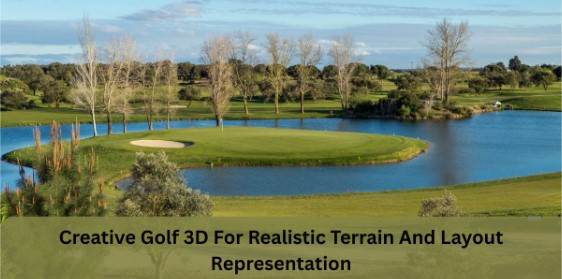
Golf course design is inextricably linked to the land on which it sits. Other than perhaps a few architectural projects, courses rely heavily on natural terrain, elevation changes, and drainage patterns, plus long sightlines that directly influence both playability and aesthetic appeal.
Accurately representing these elements has always been one of the biggest challenges in course planning and presentation. This is where Creative Golf 3D has become a real game-changing tool, which enables designers and developers to present terrain and layouts with a realism that traditional drawings lack.
3D visualization converts raw site data into immersive, accurate visuals that enable stakeholders to understand not just what a course looks like but how it really works within its landscape.
Why Terrain Accuracy Matters in Golf Course Design
Land forms the backbone of any golf course. Subtle land changes in elevation that promote drainage, shot strategy, visibility, and comfort in walking often go underappreciated but are very costly to redo once construction commences.
While traditional 2D contour maps are technically correct, intuitive clarity is absent.
Realistic 3D terrain representation bridges this gap by converting elevation data into a visual form that conveys land characteristics instantaneously.
Translation of Site Data into Realistic Landscapes
Modern golf course visualization begins with accurate site information: topographic surveys, GIS data, and environmental inputs. These form the basis for a very detailed digital terrain model.
3D visualization converts this data to:
- Realistic land contours
- Smooth elevation transitions
- Naturalistic Slopes and Landforms
Instead of abstract lines and numbers, the stakeholders see a terrain emulating real conditions. This accuracy instills confidence in both planning and design decisions.
Course Layout Visualisations in Natural Environments
A lay of the land is more than a sequence of holes; it is a well-orchestrated journey through the landscape. Understanding how the holes interface with the topography is integral to understanding strategy, flow, and aesthetics.
3D visualization allows designers to place the layouts directly onto modelled terrain. Fairways trace natural slopes, greens naturally sit within landforms, and hazards interface realistically with elevation changes.
Creative Golf 3D, at this stage of development, ensures the layouts are not viewed in isolation but as part of a living landscape; hence, the design intent is clear and credible.
Sightline and Visibility Analysis Enhancement
Sightlines are a principal consideration in the design of a golf course: players need to see landing areas, hazards, and targets; designers can frame views with the topography and vegetative cover.
Realistic 3D terrain models enable teams to:
- Assess visibility from tees and fairways.
- Identify blind shots or visual obstructions.
- Adjust grading or layout to enhance clarity.
This visual review enables enhancements in both playability and aesthetics before actual construction can begin.
Supporting Accurate Grading and Earthwork Planning
Earthwork is one of the highest-priced items in golf course construction processes. Poor understanding of topography at an early project stage may result in excessive cut-and-fill operations and unexpected costs.
3D Terrain Visualization for Planners and Engineers:
- Assess Grading Feasibility
- Visualise proposed landform changes
- Balance earthwork more effectively
Improved Understanding and Decision-making by Stakeholders
Realistic 3D visuals create a common vision for the site. They can show stakeholders how the land flows, how the holes are situated, and how the course interfaces with its surroundings.
This clarity leads to:
- Faster Approvals
- More targeted feedback
- Fewer misunderstandings
Decisions are based upon visual evidence and not assumptions.
Seamlessly Integrating Natural and Built Elements
Golf courses seldom are stand-alone entities. Clubhouses, cart paths, bridges, water features, and surrounding developments all must be integrated into the landscape.
3D visualization shows how these elements interact with the landscape:
- Buildings naturally sit on graded land.
- Paths logically follow elevation changes.
- Water features align with natural drainage.
This holistic view makes sure the course is cohesive and does not feel imposed on the land.
Supporting Environmental and Regulatory Review
Other major concerns of the modern golf course projects are environmental sensitivities. Regulators and environmental consultants need to know how the design affects the existing land features.
3D terrain models could explain the following :
- Preservation of natural contours
- Minimum disruption to sensitive areas
- Thoughtful Integration with Existing Ecosystems
Visual evidence supports environmental submissions and secures easier approval procedures.
Improve Presentation Quality without Compromising Accuracy
While realism adds visual attractiveness, accuracy is still important. The visuals of terrain and layouts must be derived from actual design data if credibility is to be maintained.
High-quality 3D golf visualization balances:
- Technical precision
- Naturalistic rendition
- Clear Communication
Many developers work with the best 3D rendering company to make sure that the terrain visuals are brilliant but informed by real planning data.
Long-term Value of Terrain-Based 3D Models
Besides, realistic terrain models are not limited to initial presentations only; the assets can be reused throughout updates in the life cycle of the project.
They support:
- Design Refinements
- Construction Coordination
- Visual Merchandising and Promotion
- Future enhancements or redesigns
Along with consistency throughout all phases of the projects, the long-term value is ensured by increasing the return on investment.
Early Visualization to Reduce Risks
One of the major advantages of realistic terrain representation is risk reduction. Problems such as awkward slopes, drainage conflicts, and poor visibility that could otherwise emerge during construction are envisioned beforehand.
Setting a New Standard in Golf Course Visualization
With these growing expectations, realistic land and layout representation are becoming the rule rather than the exception. This sets up an expectation among stakeholders for visuals that represent how a course will exist in the real world.
Projects involving 2D drawings tend to appear either outdated or too vague, regardless of how well the design might have been envisioned.
Conclusion
Effective topography and layout representations are the backbone of any successful golf course and are vital in effective planning and communication. Transforming often complex site data into photorealistic, immersive visuals, Creative Golf 3D lets designers and developers present golf courses with clarity and confidence never before possible. From early land evaluation through to stakeholder approvals and beyond, realistic 3D visualization has become an indispensable tool in the delivery of well-planned and visually compelling golf course projects.